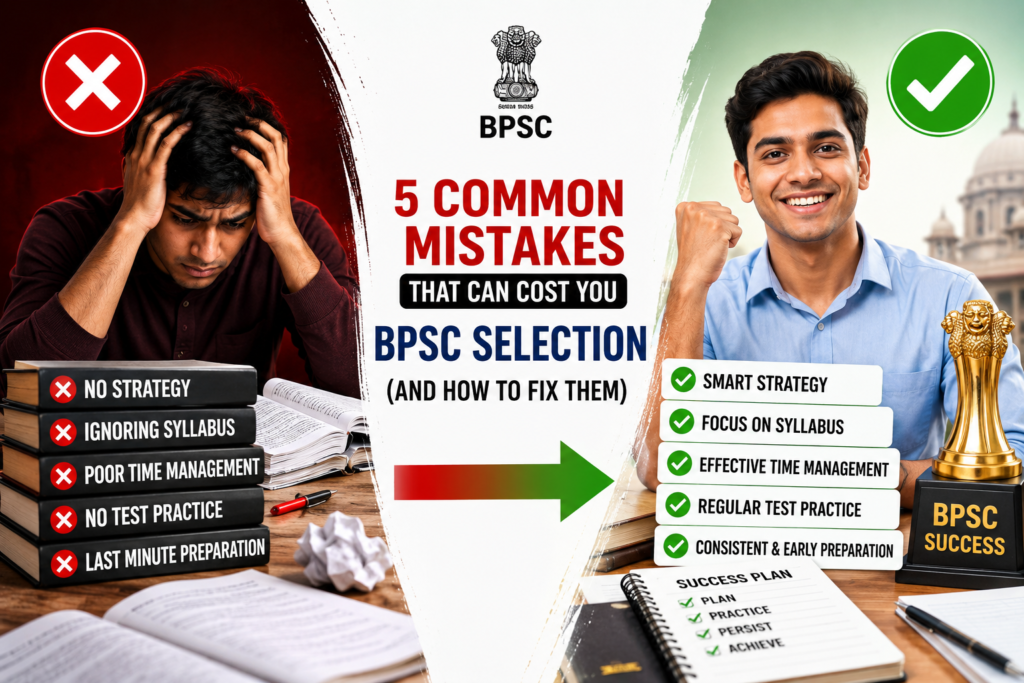
Let me be honest with you. BPSC preparation is not a one-year sprint. It’s a 2-3 year marathon for most. And in this long journey, almost everyone makes mistakes. The difference between selection and rejection is often not how much you know — but what you avoid doing wrong.
I’ve been there. I’ve made these mistakes. I’ve seen coaching toppers crash and average students sail through. So let’s break down the 5 most common, most deadly mistakes — and exactly how to fix them.
Let me be honest with you. BPSC preparation is not a one-year sprint. It’s a 2-3 year marathon for most. And in this long journey, almost everyone makes mistakes. The difference between selection and rejection is often not how much you know — but what you avoid doing wrong.
I’ve been there. I’ve made these mistakes. I’ve seen coaching toppers crash and average students sail through. So let’s break down the 5 most common, most deadly mistakes — and exactly how to fix them.
Mistake 1: Ignoring Bihar-Specific Topics Until the Last Month
This is the classic UPSC hangover. Students read Laxmikanth for Polity, Spectrum for Modern History, and think they’re done. Then BPSC asks — “Which treaty was signed between the East India Company and the King of Bihar in 1765?” or “Name the first Chief Minister of Bihar after the 1977 elections.”
What actually happens:
You freeze. You guess. You lose 2–3 easy marks — which later become the difference between your name on the final list and a ‘not selected’ status.
The hard truth:
BPSC is not 70% UPSC + 30% Bihar. It’s 50% Bihar-specific understanding. Especially in Mains, the Bihar papers will tear you apart if you’ve only studied national-level books.
What to do instead (practical steps):
- First, get a dedicated BPSC Bihar special book. There are many — pick one and stick to it.
- Make separate notes for:
- Bihar modern history (1857–1947, with focus on Champaran, Quit India movement in Bihar)
- Bihar’s post-independence politics (chief ministers, key schemes, caste movements)
- Current Bihar schemes — Saat Nischay Part 1 and 2, Har Ghar Nal Ka Jal, etc.
- Bihar’s geography — rivers, soil types, droughts, floods.
- Spend at least 1–2 hours daily on Bihar topics. Yes, daily.
Example: In 2021 BPSC Mains, a question came on “Bakasht Movement in Bihar.” Most UPSC-style students hadn’t even heard of it. Those who had prepared Bihar specific — they smiled and wrote a full page.
Mistake 2: Current Affairs Overload — Reading Everything, Retaining Nothing
I see students with 8–10 current affairs sources. Monthly magazines from 4 different publishers. Newspaper cuttings piling up like a mountain. And at the end of the month — they can’t recall 5 important facts from what they read.
Why this happens:
We confuse collecting information with learning. FOMO (fear of missing out) makes us think “agar maine yeh source nahi padha, toh kuch reh jayega.” But the truth is — you’re just burning time.
What I learned the hard way:
I used to read The Hindu + Indian Express + Dainik Jagran + three magazines. By evening, my head would spin. Then one day, I took a test — I scored lower than a friend who just read one newspaper properly and made his own notes. That was my wake-up call.
Fix this right now:
- Choose one national daily (The Hindu or Indian Express).
- Choose one Hindi newspaper (if you prefer, else stick to English).
- Choose one BPSC-specific current affairs monthly (there are good ones available locally).
- That’s it. No more.
- Maintain a thin notebook (not fat one). Write down:
- 3 national news
- 3 Bihar news
- 2 international news (only if relevant to India)
- 1 scheme/policy
- Revise this notebook every Sunday. That’s non-negotiable.
For Bihar current affairs specifically:
Follow the official website of Bihar government (state portal), and read local editions of newspapers like Hindustan Times (Patna edition) or Dainik Bhaskar (Bihar focus). Also, note down announcements from the Bihar Chief Minister’s office — they love asking those.
Mistake 3: Answer Writing Practice — “Kal Se” Never Comes
You’ve made a beautiful timetable. You’ve bought smooth pens. You’ve printed sample answer sheets. But when it’s time to actually write, you find an excuse: “I’ll first complete this chapter.” “Let me understand this topic properly.” “I’ll start next month.”
The reality check:
Answer writing is a skill. It’s not a byproduct of reading. You can read 100 books — but if you’ve never written a 200-word answer under a clock, your Mains will be a disaster.
A real example from my coaching days:
I knew a student who had read the entire GS syllabus 3 times. He could explain any concept verbally. But in the first Mains mock test, he attempted only 12 out of 25 questions. His hand started paining after 45 minutes. His answers were messy — no introduction, no conclusion, just random bullet points. He failed Mains by 8 marks.
The solution (practical plan):
- Start small — from the very first month of your preparation. Not after finishing syllabus. From day 30.
- First 2 months: Write 1 question daily. That’s it. Any topic. Just get used to forming sentences under pressure.
- Next 3 months: Write 3 answers daily. One from GS Paper 1, one from GS Paper 2, one from Optional. Time each answer — 7 minutes for 150 words, 12 minutes for 250 words.
- After 6 months: Write full-length Mains mock tests. At least one every two weeks.
A trick that works:
Keep a separate “Mistake Diary” for answer writing. After every answer you write, note down one thing you did wrong — “too long intro”, “no data”, “conclusion missing”. Next time, fix only that one thing. Slowly, your answers will improve.
Mistake 4: Optional Paper Neglect — Either Too Much or Too Little
Two types of optional takers in BPSC:
Type A — The “Optional Is My Backup” Student
He thinks GS is the real deal. Optional is just there to fill marks. So he studies optional only during weekends, or worse, leaves it for the last 2 months before Mains. Result? Scores 60–70 in optional when 110+ was needed.
Type B — The “I Know This Subject” Student
He has a degree in History/Political Science/Geography. He thinks “I’ve been studying this for 3 years, how tough can it be?” He barely opens the optional books. Then in the exam, the questions are at a different depth. He gets stuck.
What the toppers do differently:
They treat optional more seriously than GS. Because optional marks are within your control — GS can be unpredictable.
Action plan for optional:
- Start optional preparation from month one.
- Divide your optional syllabus into small topics. Complete 1–2 topics per week.
- For every topic, write at least 5 potential questions and answer them.
- Collect PYQs (previous year questions) of your optional for last 10 years. Solve all of them, not just read.
- Join a test series for optional only. Don’t skip it.
One more thing:
Don’t keep changing your optional. I’ve seen students start with Sociology, then shift to Public Administration after 4 months, then to Geography after 8 months. That’s a guarantee for failure. Choose once, and stick.
Mistake 5: Mental Exhaustion — When You’re Empty But Still Running
Nobody warns you about this. The first 6 months feel okay. By month 8, the loneliness starts. By month 12, you’re questioning everything — “Am I even capable?”, “What if I fail again?”, “My friends are earning, I’m still sitting with Laxmikanth.”
The physical signs you ignore:
- You can’t sleep properly.
- You feel irritated with family for small things.
- You stop calling your close friends.
- You open a book and stare at the same page for 30 minutes without reading a word.
- You feel guilty if you take a break.
This is burnout. And it’s not your fault.
What helped me (and might help you):
- Accept that breaks are not waste. Your brain needs rest just like your body. Would you run a marathon without drinking water? No. So why study 12 hours straight without a real break?
- One complete day off per week. No books. No notes. No BPSC YouTube videos. Go out. Meet a friend. Watch a movie. Do nothing. I promise you — Monday morning you’ll feel sharper.
- Talk to someone. Not necessarily a counselor. Just a parent, a sibling, a trusted friend. Tell them “I’m feeling low.” You don’t need solutions. Just saying it out loud reduces the weight.
- Small wins matter. Instead of “I’ll finish 5 chapters today”, keep a target like “I’ll read 2 chapters and make notes.” When you achieve it, reward yourself — a piece of chocolate, a cup of good tea, 30 minutes of your favorite song. This keeps your brain motivated.
A hard truth:
If you break down completely 2 months before Mains, all your hard work of 18 months goes to waste. So being mentally fit is not optional. It’s as important as finishing the syllabus.
A final note — from someone who has been there
I’m not writing this as a topper who cracked BPSC in first attempt. I’m writing this as someone who failed, learned, struggled, and eventually understood what actually matters.
These 5 mistakes — you’ll see them everywhere. In the mirror, in your friend’s preparation, in the stories of those who couldn’t clear.
But here’s the good news: every single one of these mistakes is fixable. You don’t need a magic trick. You just need to:
- Respect Bihar specific topics.
- Limit your current affairs sources.
- Write answers from Day 30.
- Love your optional.
- And most importantly — be kind to yourself.
If you avoid these five traps, you’ve already eliminated 70% of the reasons people fail.
Now, go. Make your own plan. Start small. And remember — this exam is tough, but you’re tougher than you think